
The Wonders of Thermal Color Changing Paint (5 Main Applications)
Thermal color changing paint, also known as thermo color changing paint, is a kind of new material. It changes colors with the temperature change. Whether
Home > Pigment Uses > Thermochromic Pigment Uses
I. Temperature sensing
Due to temperature-based color changes, thermochromic pigments are widely used in temperature sensing. Taking novel temperature tags for example, thermochromic pigments show the temperature beyond the desired range in order to identify faults in time. In liquid crystal thermometers, thermochromic pigments are visual indicators of temperature variations.
II. Product safety
Thermochromic pigments are widely used for product safety. For example, thermochromic pigments are used in beverage bottle caps to indicate whether beverage is too hot. If thermochromic pigments in beverage bottle caps change, consumers will know that beverage is too hot. They can take appropriate measures to avoid burns.
III. Smart fibers
Thermochromic pigments are used in smart fibers. Smart fibers are able to sense and respond to environmental changes. If thermochromic pigments are used, smart fibers will change colors in response to environmental change. For example, fibers may change from blue to red, indicating the body temperature rise.
IV. Decoration
Thermochromic pigments are also used in fabrics and artworks. If thermochromic pigments are used, fabrics will show different colors in a heat-sensitive environment, thus improving the dressing and creativity. In artworks, thermochromic pigments are used in painting for unique tones and effects.
In short, thermochromic pigments are interesting and practical. They have brought innovative and practical solutions in various fields.
In addition to temperature indication, thermochromic pigments are widely applied in printing, textile, clothing, toys and other daily necessities.
Thermochromic microcapsule powder are resistant to maximum 280℃, with a particle size of 1-10μm. They also have good solvent resistance and dispersibility. Thermochromic water emulsion is a kind of water-based dispersing agent containing microcapsules. It has a particle size of 1-6μm and solid content of about 48%. It can be applied in water-based screen printing, coating, ink, dyeing, etc.
Thermochromic powder can be used as an additive and paint to make thermochromic plastic and ceramic toys and daily necessities. Taking smart tableware such as spoons and bottles for babies for example, thermochromic powder (pigment) is used in spoon handles or bottle mouths. If food is very hot, the tableware will change color, indicating that the food is not edible. Thermochromic ink is applied on the outside of ceramic cup. If water in the cup exceeds the normal temperature, the cup will change its color as a warning. Color-changing toys, switches, plastic cups and other products are novel plastic products with thermochromic powder. Thermochromic paints are applied in clothing, stickers, packages, footwear, leather, glass, hardware, etc.
1.1 Thermochromic cups
Thermochromic cups are heat-sensitive cups containing thermochromic pigments. They change their colors based on the temperature of hot beverage inside. They show a color if beverage is not hot. If the beverage temperature rises, cups will rapidly change their colors. They are not only funny cups, but also can be used in teaching, advertising, etc.
1.2 Thermochromic color paints
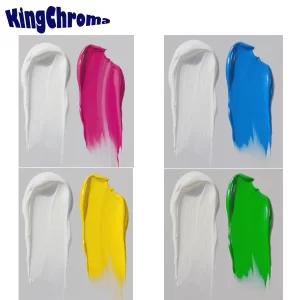
Thermochromic pigments are applied in color paints. They are used in some artworks and paintings. Artists can adjust the colors and patterns of artworks based on temperature changes to create unique effects.
1.3 Cosmetics
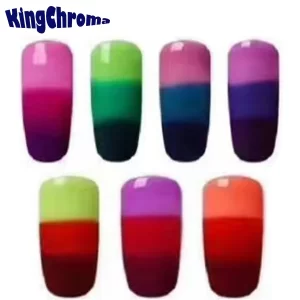
Thermochromic pigments are applied cosmetics, such as lipsticks and nail polishes. They can change their colors based on the body temperature to achieve personalized effects.
1.4 Thermochromic stickers
Thermochromic stickers contain thermochromic pigments. They change their colors based on temperature changes. They can be applied in packages, toys, office supplies and so on, with good playability and decorative effects.
1.5 Thermochromic clothes
Thermochromic pigments are used in clothes. Some clothing manufacturers use thermochromic pigments to product clothes, which can change their colors based on changes in the body temperature. Such clothes are popular with young people. They show different patterns or colors according to body temperature changes, with better funny and personalized effects.
Thermochromic ink is the basic material used to make various color-changing products. It is a special printing material that can change color as the temperature changes. It is widely used in clothing, handicrafts, or water-borne environmentally friendly silk screen printing. Thermal cups, clothes and spoons that are commonly seen in our daily life are made of such thermal paste. How to prepare it?
We can use corresponding diluent to dilute the thermochromic ink before use (or we may use customized water-based color paste and dilute it with water). For the thermochromic powder selected for screen printing, the number of mesh shall be 150-200. Professional printing material manufacturers recommend the use of white or light white color for background printing in order to improve the degree of difference in the color change of thermochromic ink. We should store the thermochromic ink in a closed, dry and dark place and avoid direct sunlight.
The manufacturer of KingChroma color-changing pigment employs the high-efficiency dispersion technology that is independently developed by it, and carries out production and management in accordance with ISO9001 standard quality management system. The use of thermochromic ink can avoid defects such as uneasy weighing, color deviation and poor dispersion caused by the direct use of thermal powder. It is an indispensable raw material for producing high-end thermal fabric and cloth.
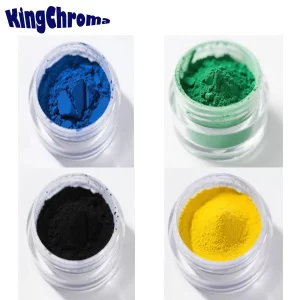
Thermochromic pigment (also called heat sensitive powder) is a kind of temperature sensitive powder material. With capability of changing color along with temperature changes, it can be widely used in various products including but not limited to:
On the whole, thermochromic pigment has a broad application potential. It can be used in many products to enhance interest and interactivity.
I need to make a batch of anti-counterfeit materials whose color changes with temperature. Can I use the thermochromic powder? Is there any case of application in anti-counterfeit technology?
Anti-counterfeit technology is a unique function of thermochromic powder. Such anti-counterfeit technology is based on the color-changing requirement of the thermochromic powder. Thermochromic powder can quickly change its color with the change of ambient temperature, bringing a dynamic color effect on the colored object.
Thermochromic pigments show different colors based on temperature changes, with some sense of technology and innovation.
Thermochromic pigments have broad prospects in many fields, such as drinkware, cosmetics, clothing, etc.
Thermochromic pigments can be easily produced, so they are suitable for mass production.
Colors of thermochromic pigments are restricted by their properties, so some colors may not be achieved.
The properties of thermochromic pigments may decay over time or based on operating conditions. Therefore, regular replacement or maintenance is required.
The production cost is high, so thermochromic pigments are relatively expensive.
Thermochromic powder is made of electron transfer type organic compounds. Electron transfer type organic compounds are organic color compounds with special chemical structures. They molecular structures change due to electron transfer at certain temperatures, leading to color changes. Thermochromic products not only have bright colors, but also change from a color to colorless status and vice versa. Heavy metal complex and liquid crystal reversible temperature-sensitive compounds do not have these properties.
Raw materials of thermochromic powder do not contain chromium, lead and other toxic heavy metals. The new-generation thermochromic powder of Lijin do not contain BPA. They are not toxic or irritating to the human skin, but are fully compliant with food safety certification requirements. As long as plastic is safe, thermochromic plastic products will be safe and non-toxic.
I am a designer from Adidas. We have a T-shirt that changes colors at different angles. Can the effect be mixed with other colors to the thermochromic pigment for fabric?
Yes, you can first use black thermochromic powder as a base color, and then cover it with chameleon powder. When it does not change color, it will have a colorful chameleon effect. When touched by hand, the color will be pearl white and colorful. Make your clothing innovative and outstanding.
Thermal powder is a kind of material that changes its color as the temperature changes. It is often used for temperature indication and temperature sensing. What kind of material can be used together with thermal powder?
The following gives some common materials that match thermal powder:
1. Printing paper: We can combine thermal powder with printing ink. In this way, we can make temperature indication cards and tags that can change color.
2. Glass: We can combine thermal powder with glass coating to make glassware and glass signboards with the function of temperature indication.
3. Coating: We can add thermal powder to coating, so as to make wall coating and furniture coating that change color.
4. Plastic products: We can fuse thermal powder with plastic, so as to make cups, tableware and toys with the function of temperature indication.
5. Embedded materials: We can embed thermal powder into silica gel and resin, so as to make temperature-sensitive wristbands, watches, and mobile phone shells.
Please note that the specific matching material depends on the application requirement and the property of thermal powder to be used.
Thermochromic powder is a kind of organic color-changing pigment. Such color-changing pigment can change color with temperature change. Heavy-metal double-salt complexes and liquid-crystal reversible temperature-sensitive and color-changing substances do not have such property. Can we directly dissolve thermochromic powder in water? Can we use it on cups?
We cannot directly dissolve temperature-sensitive and color-changing pigment in water. If we want to prepare thermal paste, we can directly mix it with transparent ink before use. In addition, thermochromic powder can also be used for color matching. We can match color-changing pigments with different colors/color-changing temperatures/series. In this way, we can obtain more colorful color-changing effect.
Temperature-sensitive and color-changing cup is a kind of cup that changes color when heated. For hot color-changing cup, when the water temperature is above 40℃, it will change color. For cold color-changing cup, when the water temperature is below 20℃, it will change color. Water-sensitive and color-changing cup has not been popularized now. The principle is that the thermochromic powder pigment is painted on the cup wall and the material is a kind of heat-sensitive material.
Thermal color changing paint, also known as thermo color changing paint, is a kind of new material. It changes colors with the temperature change. Whether
As one of the most creative advancements in the world of automotive, thermochromic paint generates a stunning, dynamic effect that enables the appearance of a
You can imagine driving a car that hues are switched under the sun’s warmth. You are not watching a futuristic movie; it is the fact
We are Ready to Support Your Thermochromic Pigment Uses
Kingchroma industrial park, Minqing Raod, Longhua Street, Longhua District, Shenzhen City, Guangdong Province, China