


How to use photoluminescent and photochromic compounds in dyes?
Photochromism and photochromic compounds In 1867, Fritsche discovered that yellow tetracene faded under the influence of light in air and regenerated upon heating. In 1876,
Home > Pigment Uses > Photochromic Pigment Uses
1. Photochromic pigment for Plastic products: The recommended ratio of photochromic pigments is 0.8-3%. They are suitable for injection and extrusion of plastic materials, including PE, PP, ABS, PS, PVC, PU, TPU, TPR, EVA, photosensitive PE masterbatch, photosensitive PMMA masterbatch, etc.
2. Photochromic pigment for Photochromic inks: water-based and oil-based inks. There are dedicated inks for fabrics, paper, synthetic films, glass, ceramics, metals, plastic and wooden products. They have good adhesion and color-changing effects. Photochromic coatings and paints apply to all surfaces. Other products of KingChroma: I. Thermochromic raw materials: color changes are controlled by differences in temperature. Currently, the available products include low-temperature thermochromic products, hand-felt thermochromic products, high-temperature thermochromic products, thermochromic powder for plastic injection and extrusion, and dedicated inks for other materials.
3. Photochromic pigment for Paints: The recommended ratio of photochromic powder is 10-30%. Photochromic powder is suitable for surface paints, including PMMA spray paint, ABS spray paint, PVC spray paint and water-based spray paint.
Inks: The recommended ratio of photochromic pigments is 20-40%. Photochromic pigments are suitable for printing of fabrics, paper, synthetic films, glass, etc.
1.1 Injection molding and extrusion:
Features: thick capsule wall, high strength, good heat resistance, even dispersion, fewer residual colors.
1.2 Scope of application
It can be used in injection molding and extrusion of transparent or translucent plastics, such as polyethylene (PE), polypropylene (PP), polyene (PS), soft polyvinyl chloride (S-PVC), AS and ABS. It can also be mixed with unsaturated polyester, epoxy resin, plexiglass or nylon monomer in casting, mold pressing and curing.
1.3 Dosage:
During injection molding, extrusion, casting, mold pressing and curing, photochromic pigments account for 0.4-3.0% of plastics, usually 0.6-2.0%. Photochromic pigments should be fully mixed with plastic particles (use a small amount of white oil during mixing). Ordinary pigments (or dyes) should account for about 0.5-2.5% of photochromic pigments if they are mixed.
1.4 Colorants:
During mass production, photochromic pigments are mixed with polyethylene wax or polystyrene wax to make the color masterbatch, in which pigments account for 10%. Then they are mixed with plastic particles. In this way, photochromic pigments are dispersed more evenly.
1.5 Temperature:
The processing temperature should be below 200℃ and never greater than 230℃. In addition, the time of material heating should be minimized. (High temperature and long-time heating will affect the color-changing properties of these pigments.)
Description:How can we avoid color difference due to improper operation of photosensitive powder?
Answer:
1. Avoid processing such powder above 280 degrees centigrade.
2. Avoid using it together with UV absorber.
3. Be careful with additives and base materials, as the photosensitive powder is highly sensitive to polarity, different additive or base material may cause color difference.
4. Storage: Store such powder in a sealed, dry, and dark place, without direct sunlight.
5. Toxicity and safety: Photosensitive powder is non-irritating to skin, and safe for handling and operation. It does not contain any substance harmful to human body, and therefore, it is consistent with safe toys and food packaging specifications.
Coatings: It is recommended to add photochromic powders at a proportion of 6-20%, suitable for various surface coating products, including PMMA spray paint, ABS spray paint, PVC spray paint, water-based spray paint, etc.
Inks: It is recommended to add photochromic pigment powders at a proportion of 15-30%, suitable for printing on various materials, including fabric, paper, synthetic film, glass, etc.
Plastic Products: It is recommended to add photochromic powders at a proportion of around 0.8%, suitable for various plastic materials in injection molding, extrusion molding, and products with high color concentration, such as photochromic PE masterbatch and photochromic PMMA masterbatch.
Description:When using photochromic pigment powder, we need to dissolve it and mix it into various pigments before we can use it. What is the method of dissolving photochromic pigments?
Answer: Photochromic pigment powders can be dissolved. When photochromic pigment powders lose ultraviolet irradiation or when the temperature rises above 45ºC, the photoreceptor molecular bond closes, i.e., they return to their original color. Various solvents, polarities and substrates of photochromic pigment powders will affect the color change of OP powder, so the same dye will have different color performance in different solvents, polarities and different substrates.
Can the different colors of photochromic pigment products be mixed with each other, and can they be mixed with other color-changing pigments?
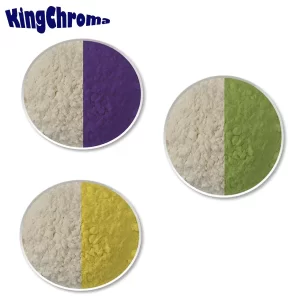
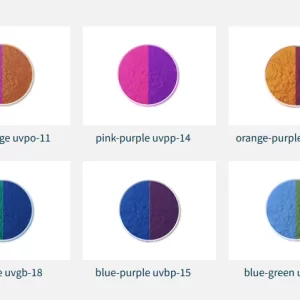
The basic colors of photochromic pigment products are purple, blue, yellow, and red. Good and stable color changeability, high fluidity, easy to disperse evenly, can be mixed with each other or shared with other pigments and fluorescent pigments.
Description: For all the time, we are using umbrella of unchangeable color. Can we add photosensitive pigment to the umbrella pigment so that the color can change under different outdoor lighting conditions?
Answer: The answer is yes. Sun umbrellas applying photosensitive pigments will change in color when exposed to sunlight/UV radiation, and return to its original color when the sunlight/UV is lost. Color-changing sun umbrella is one that fully utilizes the color changing principle of such powder to change its color from being “colorless to colored” under sunlight exposure.
The use of photosensitive pigments in umbrellas is a breakthrough for the traditionally unchanged color and pattern of umbrellas. When exposed to sunlight, the umbrella surface can gradually show a colorful appearance, and return to its original color when sunlight is blocked. The color change can be cyclic, performing the magic of color variation in light, bringing more surprises to life.
Description: It is often reported that fabric applied with photochromic powder will fade after washing, thus affecting the product quality. So, how to make the powder stay put? Here is a good way to do this for everyone.
Answer:
Description: Photochromic powders are special material that can change color with light. There will be some difficulties when using it on clothing. What precautions are there?
Answer: You need to do the following before using photochromic powders on clothes:
1. Choose proper material: Photochromic powders usually applies to natural or synthetic fibers such as cotton, silk, and nylon. Make sure your clothing material is suitable for this kind of powder.
2. Mix the powder: Before using it on clothes, it is often necessary to mix it with certain adhesive or other medium. Make sure to mix it correctly according to instruction.
3. Ensure ventilation: Ensure that the operating environment is airy enough to use this powder. Sufficient ventilation can reduce the potential harm to human body, and help distribute the powder more evenly on clothing.
4. Evenly apply: You need to brush or spray the powder evenly on clothes. It must be evenly applied to avoid uneven color changes.
5. Prevent pollution: Do not touch substances such as food or beverage when using the photochromic powders, as it will dye them to cause pollution or damage.
6. Pay attention to cleaning and maintenance: Select proper washing method and temperature as instructed. You need to follow the instruction so that the photosensitive effect can last longer.
Description: Recently, we are consulted that photosensitive pigment purchased from other manufacturer doesn’t change color in the sunlight, which is actually very rare. But, how to deal with it when it happens?
Answer: Usually, when the color doesn’t change, there is a great possibility of improper operation or fabric sublimation. So, we should strictly follow relevant requirements when using photosensitive pigment. Here are the complete usage precautions on photosensitive pigment:
Usage precautions:
1. Binder (resin) selection:
Resin has very important impact on the color concentration and surface luster of photochromic ink. The content of pigments in photochromic ink is far greater than that in ordinary ink. If photochromic ink is made with resin from ordinary ink, it cannot be used due to too high viscosity. Thus, it is necessary to reduce resin and increase solvents, in order to reduce the ink viscosity.
2. Solvent selection and its impact on color-changing properties
2-1 Impact of the optical refractive index of solvent on the color concentration of photochromic ink (coating)
The optical refractive index of microcapsule in photochromic pigments is about 1.50-1.54. If the optical refractive index of the solvent is the same as or close to ink, the ink will have high concentration, such as toluene, xylene and benzyl alcohol (optical refractive index: 1.496, 1.493 and 1.540, respectively). On the contrary, if the solvent and ink are greatly different in the optical refractive index, the ink will have a low apparent color concentration. Solvents only have temporary impact on the color concentration of photochromic ink. After printing is completed, such impact of solvents on ink will gradually disappear.
2-2 Impact of solvent on color-changing properties of pigment
The resistance of photochromic pigments to solvents varies. After soaking in some solvents for 6 months, the color-changing properties of photochromic pigments are not affected. But other solvents may erode and penetrate into microcapsule surfaces within a few hours to weeks. In this case, the color-changing properties of photochromic pigments will degrade and even completely disappear. After the solvent volatilization, some color-changing properties may be partially recovered, but some properties are completely unrecoverable. In general, the solvents containing 3 carbon atoms or less may cause more erosion damage to photochromic pigments, and the solvents containing 6 carbon atoms have little impact. In addition, solvents have more obvious erosion effects at high temperatures.
Notes: Finished diluents/mixtures commonly used in oil processing and some resin solutions may contain ethanol, acetone, propanol and other components harmful to the properties of photochromic pigments. Even in case of fewer harmful components, they have serious impact.
Can the different colors of photochromic pigment products be mixed with each other, and can they be mixed with other color-changing pigments?
The basic colors of photochromic pigment products are purple, blue, yellow, and red. Good and stable color changeability, high fluidity, easy to disperse evenly, can be mixed with each other or shared with other pigments and fluorescent pigments.
Coatings: It is recommended to add photochromic powders at a proportion of 6-20%, suitable for various surface coating products, including PMMA spray paint, ABS spray paint, PVC spray paint, water-based spray paint, etc.
Inks: It is recommended to add photochromic pigment powders at a proportion of 15-30%, suitable for printing on various materials, including fabric, paper, synthetic film, glass, etc.
Plastic Products: It is recommended to add photochromic powders at a proportion of around 0.8%, suitable for various plastic materials in injection molding, extrusion molding, and products with high color concentration, such as photochromic PE masterbatch and photochromic PMMA masterbatch.
Description: What are the steps of photosensitive powder injection molding? What is the mixing ratio? Are there any precautions?
Answer: Photosensitive powder for injection molding: The ratio of such powder to plastic material is generally around 0.4% – 10%, depending on the color shade of product. Add less powder for light color, and more for dark color.
Usage instruction:
Description: Can the photosensitive powder be used on sand yarn and washed in water, and will it have an effect on the color change?
Answer: Photosensitive powder can be printed on yarn with coating, but the water washing fastness is not good, because the printing surface of yarn is too small, the water fastness will be poor once washed, so water washing is not recommended.
Description: Photochromic powder is reversible photochromic substance in microcapsule, which is a spherical and transparent outer shell that neither dissolves nor melts. It is this shell that protects the photochromic substance from other chemical factors. What requires our attention when producing and storing it?
Answer: During production or storage, we should store photochromic powders in dry and dark place to avoid light fatigue. We should also ensure there is no corrosive substance such as strong acid or alkali in the environment. We should not use it with UV absorber. Different additive or base material may cause unexpected effect of the product. Due to the variety of types, usage status, and application environment of photosensitive materials, it is not possible to list them all.
Description: We want to use the photosensitive powder on animal or human hair, but the local government needs a certificate to verify whether the powder can be used on humans or animals.
Answer: Please rest assured that Kingchroma’s photosensitive powder contains SGS, Rohs and other certificates, and is non-toxic to skin and animals. We also have customers to make coloring paste for human or animal hair.
How to use photoluminescent and photochromic compounds in dyes?
Photochromism and photochromic compounds In 1867, Fritsche discovered that yellow tetracene faded under the influence of light in air and regenerated upon heating. In 1876,
We are Ready to Support Your Photochromic Pigment Uses
Kingchroma industrial park, Minqing Raod, Longhua Street, Longhua District, Shenzhen City, Guangdong Province, China